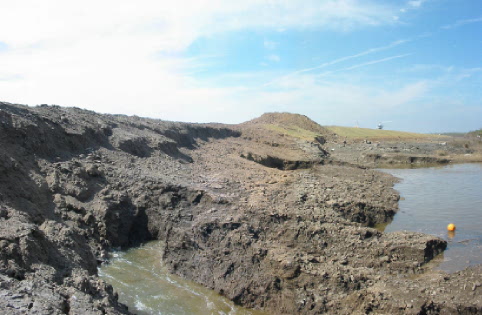
The highlight of the week was on Monday afternoon when I got to tag along on a helicopter trip to Plaquemines Parish to observe areas of unwatering repairs. The PM I’m working for, Mark Gonski, was also the PM for the unwatering task and he wanted to check on a few things. The main concern was the locally famous breach at Nairn. The levee failure occurred at a Shell Oil pipeline passing through the levee but they objected to their name being used in the breach nomenclature so it was called by the closest burg. The breach was patched with clay borrow placed over melon sized rock placed in the breach. Water was seeping through the rock at the toe in several places; actually the term flowing would be more appropriate in that water was fountaining up about 4-6 inches in one spot due to the water pressure differences. Tension fractures of the soil indicated that a +50 foot section would slough off soon. Various options of additional emergency repairs were discussed before settling placing large sandbags by helicopters protected side and then sheet piling flood side later.
|
Seepage at Protected Side Breach repair at Nairn
|
|
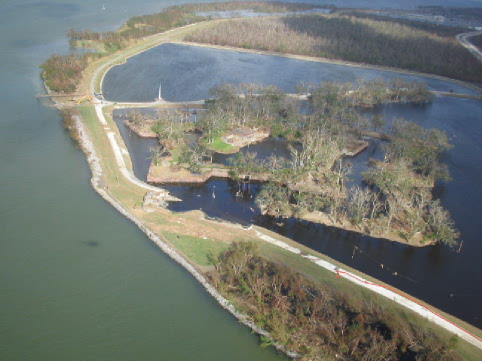
I also got to see other places on interest, including a site from my normal Formerly Used Defense Site (FUDS) job.
|
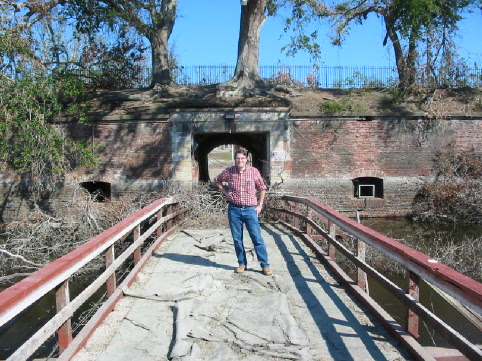
Flooded Fort Jackson - 3rd System fort built between 1822 and 1840s, later upgraded with Endicott era guns in the 1890s and used as a training base during World War 1 - 1917-1918.
|
|
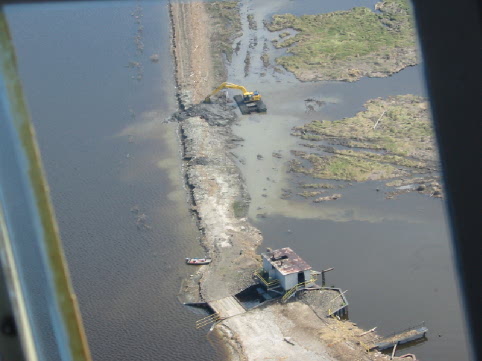
How they construct and repair their levees is a bit different down at this end of the river. Here are repairs on the back levee with the muck in the immediate vicinity.
|
"Swamp buggy" making levees repairs on the Non-Federal levees as part of dewatering
effort
|

|
|
Breach repairs at Pump Station on the Non-Federal levee
|
|
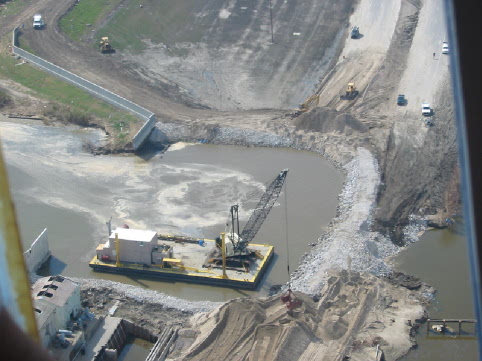
One of the most significant repairs is the ring dike cut-off of the floodwall breach at the Sunrise Pump Station. It took out state Highway 23, which is the main road in the area.
|
Breach repair at Sunrise Pump Station
|
|
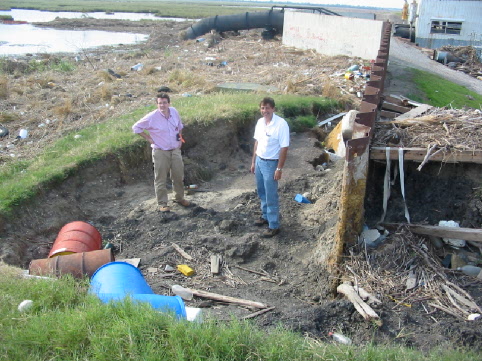
We also visited the erosion around the sheet pile floodwall tie-ins at the Hayes Pump Station. The erosion was fairly typical at ends of flood walls.
|
Randy and Mark investigate scour around sheet pile flood wall at Hayes Canal Pump Station
|
|
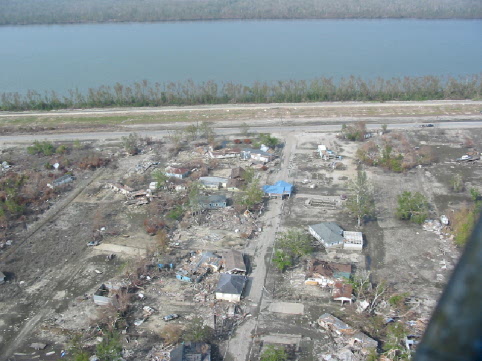
The destruction of the communities was fairly complete from Port Sulphur south. What it did to the above ground cemeteries is as good a reason as any I can think of in support of cremation.
|
Residential Property Destruction Between Home Place and Nairn
|
|
That evening I called Bethany, who had had a bumpy day. While listening to the tribulations of her day, the 2 ½ of sleep from the night before caught up with me and I drifted off. The sounds of my snoring clued her that she did not have undivided attention. Nothing tops of a bad day than having your spouse fall asleep on your retelling of it (and not noticing it for longer than you care to admit). Flowers the next morning helped restore me in her good graces. She graciously told the girls that the flowers were for all of them and Jane and Cate were quite pleased too. Cate was so pleased; she
dumped the vase of water on herself trying to get another sniff.
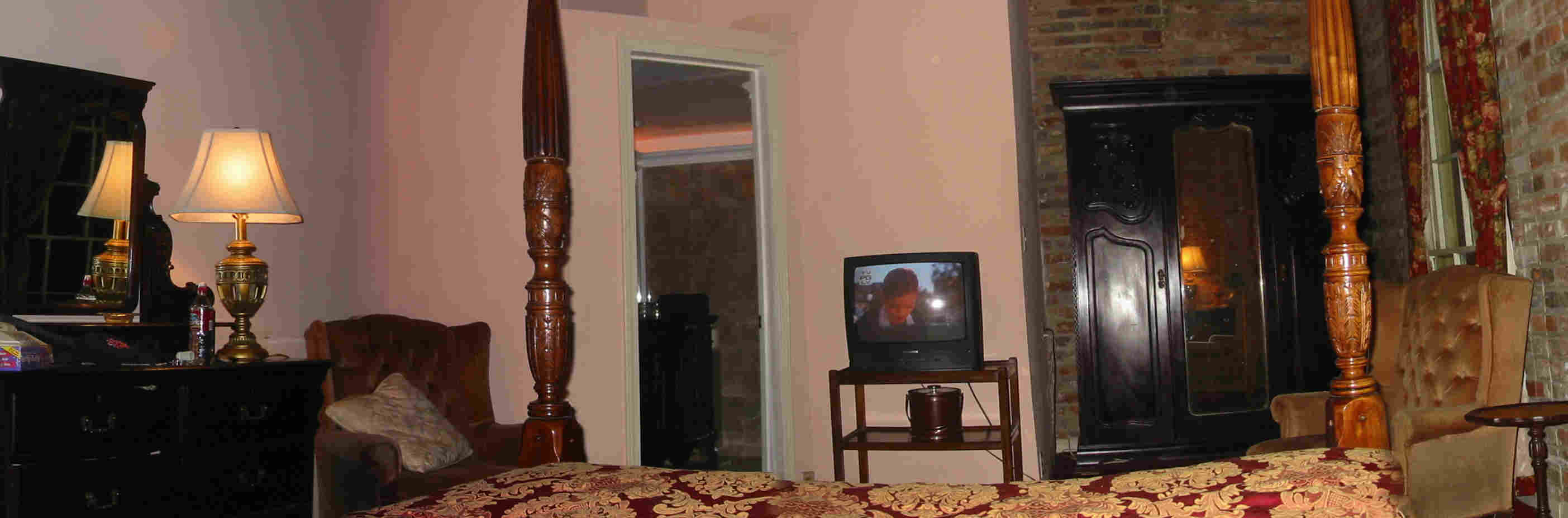
On Friday they moved us out of our charming hotel in the Quarter to the Hilton next to the downtown river Casino. A couple of people in our group weren’t pleased by the pets they provided gratis in the Olivier House (i.e. mice and roaches). This served as the impetus for our move (I only had two of the required 3 handles needed to operate the shower but I improvised and wasn't too upset). The night before we left, me an a couple guys went around the block to Bourbon Street to a place where you get 3 for 1 beers before 9 pm. While standing at the bar, a guy who bought a beer for himself, passed us the two extra ones. This happened 2 more times with different guys before we left. Pleasant but weird (and no it wasn’t one of those kind of places….and yes I’m sure).
The Hilton rooms are in excellent shape and once again I lucked out and got a room overlooking the river like my office (although I'm only there in the dark so it doesn't matter much). The lower floors and ballrooms didn’t fair as well as the roof collapsed. All the carpet has been ripped out and much of the drywall removed.
Weeks 3 thru 5 - 16 October thru 2 November
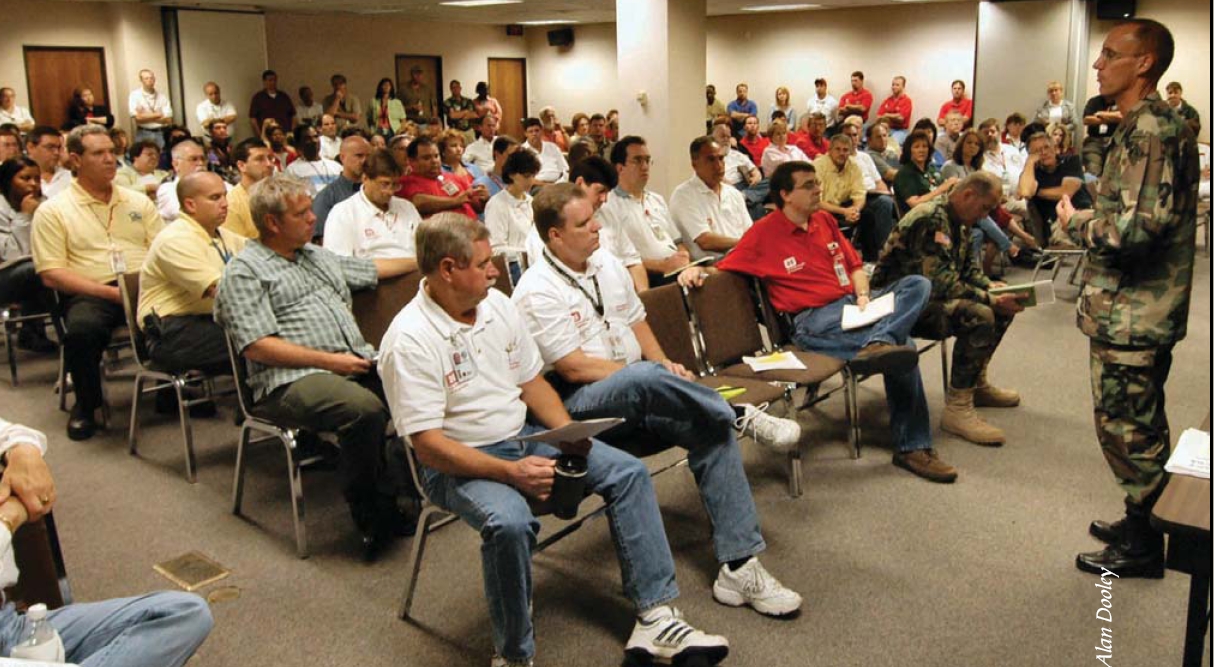
I stopped writing this blog after the third week, and caught it up some over the T-day weekend, a month or more after the fact. Below is the formation meeting of TFG where I had a front row seat (and I swear I'm not asleep, even though I look less then completely alert).
Food Front:
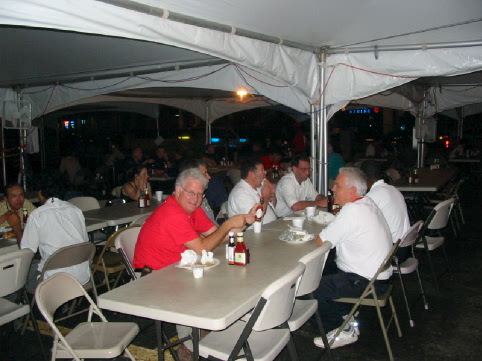
The last couple weeks we got out to eat every so often including 2 nights at Mother’s on Poydras, Drago’s in Metairie and the Bourbon Street Café. The last spot was a white table cloth kind of place where two older gentlemen were dinning at the table next to us with a white dog seated between them. A couple of our folks were a little put out by this until I pointed out that the dog had better table manners than I did (no paws on the table and didn’t gobble his food), which they had to concede was the case. Another oddity was a kegger we were invited to in celebration of the end of the Task Force Unwatering mission on a Friday night. Colonel Duane Gapinski, in charge of that mission, paid for a couple kegs that were serve your self at one of the local bars. I’ve been to a number of "keggers" while at Rolla, but never one at a bar where you served yourself (at least not while it was still open to the public). Must be another example of a more casual legal environment towards drinking down in Louisiana. It was also odd in that this is very untypical behavior for a colonel but everyone who worked with him, clearly loved this charming, gregarious, party boy.
|
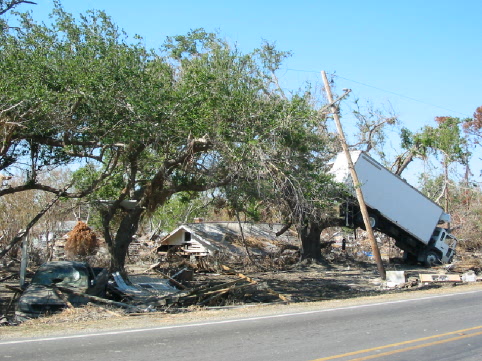
Delivery truck in tree seen while conducting levee inspections
|
|
Work Front
The last few weeks of my deployment were still very hectic but not quite as bad. No 20 hour days, but a few 14-15 our ones. Much of what I was doing was assisting in getting the contracts for the repair work completed, with much of it coming under the category of whatever it takes. There were some times where I was nothing more than a very well paid copy boy to other times where I was overseeing Biddability, Constructability, Operability and Environmental (BCOE) reviews of the draft Plans and Specifications. These tasks required coordination with most elements of New Orleans District including Contracting, Office of Counsel, Real Estate, Engineering (geotechnical, levees, structural, cost estimating), Operations, Construction and Environmental, as well as the A-E contractors, the Parish government and other elements of Task Force Hope including the Debris Removal team and Task Force Unwatering. It wouldn’t surprise me if I interacted with a third of the people in the District office (several hundred people).
I was also involved with analyzing the extent of damages and determining the limits of rehabilitation efforts required.
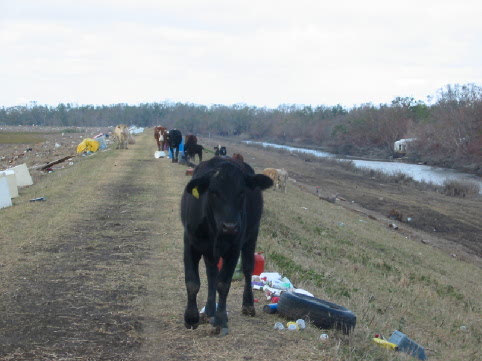
Over the last 2 weeks, I got to spend some time in the field driving all the west bank Federal levees in Plaquemines Parish (over 100 miles total). Because of the distance to and from the project and because we typically got late starts (i.e. not getting out of the District office until after lunch) it was took 6 days to complete (21, 22, 25, 29 & 30 Oct and 1 Nov). We would typically go till past dusk and drive most of the 1 ½ hours back in pitch blackness (there was no power in the lower end of the parish). It was kind of dangerous but not for the reasons you’re probably guessing. One day we almost hit a black cow in the middle of the road (the cattle were roaming free through the lower end).
|
Cows on levee
|
|
On another occasion we nearly hit a pair of full sized elks. And you’re thinking: “Elk near the marshlands of Louisiana? Randy defiantly wasn’t getting enough sleep or was hitting the bottle a bit on duty hours.” Neither was the case. A local raised them for the medicinal (?) value of the horns. I trusted my PM Mark Gonski with taking the picture for evidence but all it showed was that the camera wasn’t idiot proof.
What follows is a sampling of photographs of the damage to the levee and floodwall as well as a fraction of the personal property (homes, barges, boats, cars)
lying on the levee right of way impacting repairs.
|
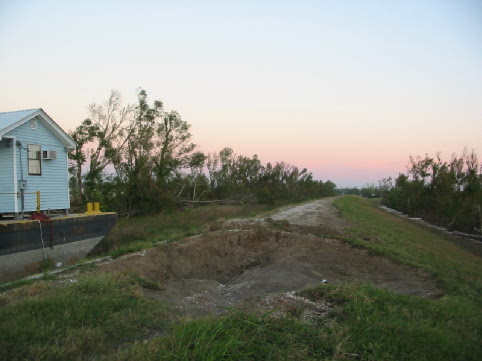
Landside scour hole induced by barge on levee; note gravel at toe of levee clearly indicating it was overtopped
|
|
|
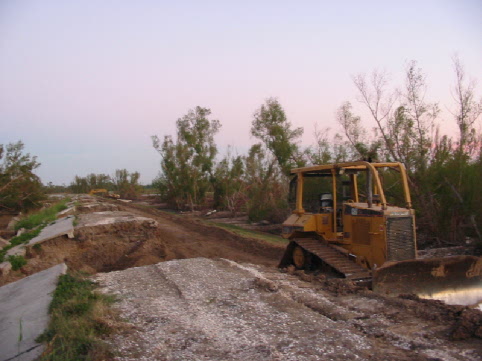
Series of 8 scour holes at Woodland
|
|
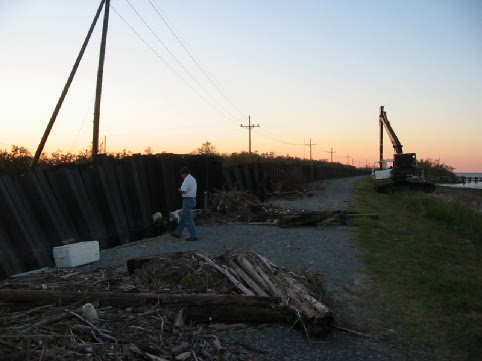
The following pictures are of floodwall damage resulting from an unclosed door through the levee allowing water to erode out the landside slope (not shown). I guess during the bug out for the hurricane the responsible person missed this. The damage resulted in almost a complete failure of the flood protection.
|
Port Sulphur floodwall damage from unclosed door
|
|
|
Erosion beneath concrete armoring at West Pointe A La Hache Water
Siphons; note sheet piling behind Gonskometer, it is the only thing holding it up.
|

|
|
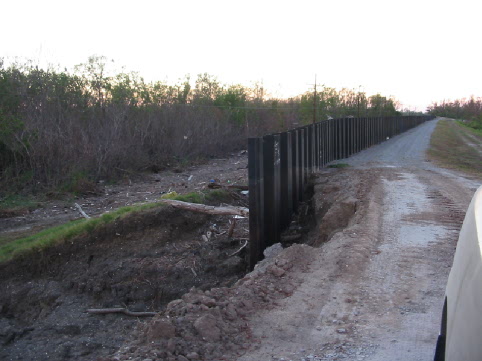
Floodwall end displaying typical erosion at levee tie-in
|
|
|
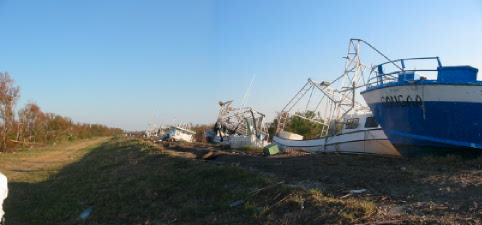
Seven stranded fishing boats on the levee near Empire
|
|
We knew that the dozen or so large barges on the main Mississippi River levee were an issue for a few weeks and there was someone working on that with the Coast Guard within TFG. As we personally drove the levee, it became clear that this person didn’t own the problem of ALL the boats on the levee but only those potentially impacting navigation. Other boats that were in the way for making levee repairs weren’t his problem. The best I can say for this attitude was, he was strictly “staying in his lane” to use the phraseology of the time. Anyway, it became clear that somebody (guess who) would need to inventory ALL the boats out, which was expanded to include cars, trucks, conex containers and houses. These were the first seven fishing boats we found. They were all in pretty good shape and will likely be in use again, if not
damaged while moving them.
|
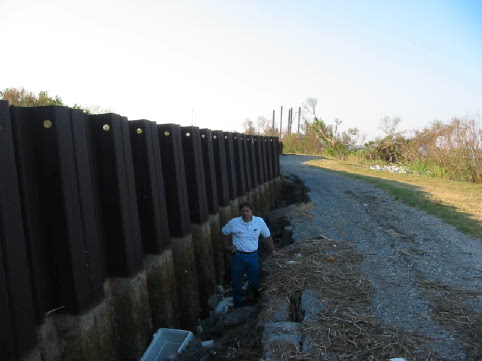
Floodwall erosion at Empire; note Gonskometer for scale
|
|
|
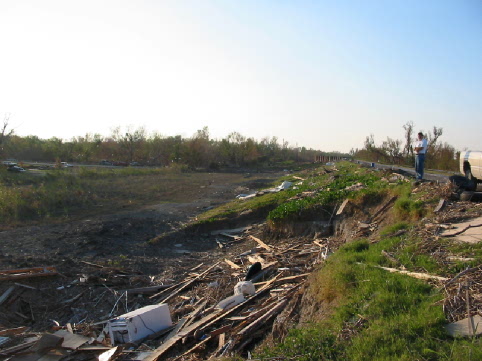
Levee scour to crown on landside of levee
|
|
|
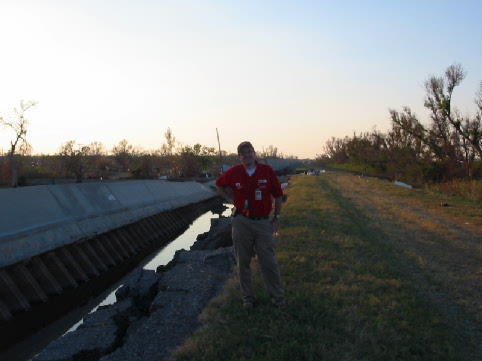
Randy at Burras floodwall failure the floodwall was originally about 6 feet to my left before the complete failure
|
|
|
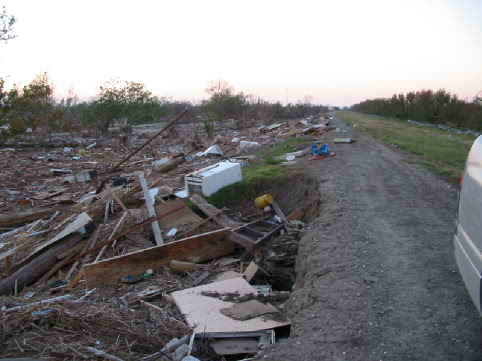
Levee scour with debris from destroyed homes
|
|
|
Randy standing outside Fort Jackson's sally port
|
|
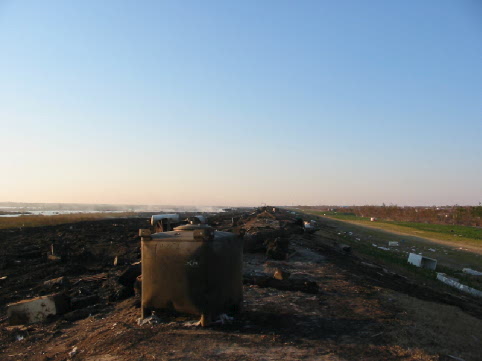
We heard word that a portion of the levee was on fire the week before, which in and of it self didn’t cause much of a stir. There were places where 2-4 feet of dried swamp grass lay on top of the levee that would have to be removed before making repairs. Where it was this thick, it would mask any damages to the levee present by obscuring the scour holes. If this dried grass burnt it wasn’t going to do any MORE damage to the levee, since the grass beneath it was mostly dead anyway. The problem was that where the fire occurred was also the stretch of levee where hundreds of pressurized containers for the off-shore oil drilling industry washed up. At least some of them contained aviation fuel but after they’re singed black there no easy way to tell what they contained. After going through a fire, the containers can be compromised and handling them is a real dicey proposition. I believe the decision to let the area burn instead of trying to fight it was a smart one. The EPA wasn’t going to have their contractors out there to remove until after the smoldering had ended (note the smoke in the picture below) and even then they wouldn’t commit to a schedule on when they would be able to clear the area. We drove on the landside toe for the 5+ mile stretch of Reach B-2 back levee that was burnt.
|
Reach B2 burnt levee
|
|
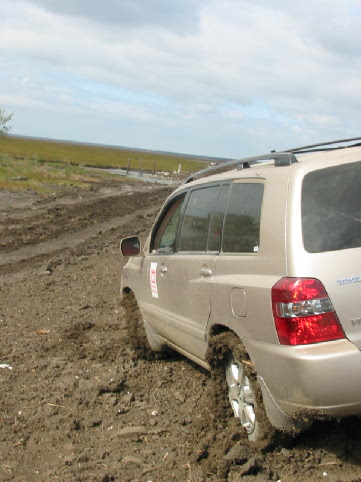
1 November is the official beginning of the rainy season in Louisiana and it didn’t disappoint us. There had been no rain the rest of the time I was there but there were some light showers that morning and it was grey and overcast. No big deal, I won’t melt. Well a little bit of water on this bare soil, or what they call soil down there and it turns to baby poop. I didn’t get us into the following predicament of sliding off the crown and pointed to the marshes but that was only because I wasn’t driving at the time. The picture doesn’t really do justice to how dicey our situation was. I did volunteer to try and drive us out. Fortunately we didn’t’ roll when making the turn at the toe of the levee, didn’t get stuck along the ½ mile of mud slopped road along the toe back (I was driving a very aggressive 20-30 mph to keep our momentum up through the muck) and didn’t flip when we drove back up the slope to the crown to get to the main road. If only my regular co-workers, who don’t let me, drive when things get tricky, could have seen me in action. I don’t think they’ll take Pat Shaw and Julie Zino’s word that it was
|
Truck in mud
|
|
|
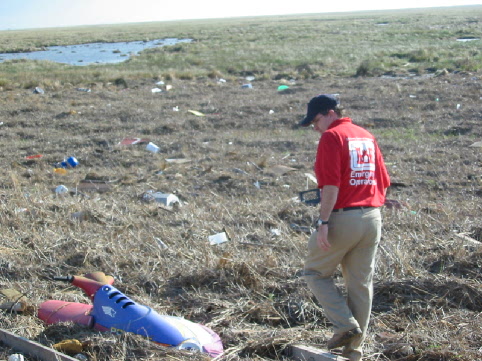
Randy looking at jet ski
|
|
|
Dozens of boats piled up on Hwy 23 at the
fishing village of Empire
|

|
Coming Home - 3 November
I think my lament about missing taking my girls Trick or Treating for Halloween must have struck the right people that it was time for me to go home and the next day they told me I could go. I flew back on the 3rd of November on day 33 of my deployment. The other St. Louis folks, except the Colonel who is stuck there for the foreseeable future, were right behind me, leaving 2 days later. Besides exceeding our original time, the other big factor was that TFG was moving to rented space at the Federal Reserve downtown and there wasn’t space for us there. The reasoning and fallout for that move is a story or two in itself but I don’t feel up to writing up my thoughts on that. One of the things that surprised me most about leaving was how reluctant I was to go. Sure I wanted to see my family, but I felt bad that so much work remained to be done and leaving the people I left behind in need. If I was a single guy, I'm sure I would had wanted to stay several weeks longer.
My homecoming at the airport was picture perfect, with Bethany and the girls meeting me just outside security. Nothing melts your heart so much as a 3 year old shrieking “Daddy” and running to you after being gone awhile.
Since I’ve been back, people have asked me about my experiences and generally I don’t know how to answer. There’s so much to say (good, bad, frustrating, sad, etc.), that it doesn’t neatly fold it self into a quick and easy answer. Generally there’s not time and most people don’t want an in-depth answer anyway. Frequently, I end up giving the safe, easily packaged answer that meets their general expectations without going into the nuanced examinations of the whys and what fors. This diatribe comes close at points though I’ve generally kept it upbeat without going into the frustrating weeds. There’s still so much more. I think I finally have a clue what it must be like for people coming back from war or other major event when confronted with similar questions. There’s just too much to say, that what gets said doesn’t really scratch the surface.

RBJC Curtis Family Front Page
 Randy in New Orleans
post-Hurricane Katrina
Randy in New Orleans
post-Hurricane Katrina